Polvilho Azedo vs. Doce: The Commercial Baker\
Commercial guide to Polvilho Azedo vs. Polvilho Doce: Understand lactic fermentation, pH acidity, and thermal expansion power in cheese breads and commercial snacks.
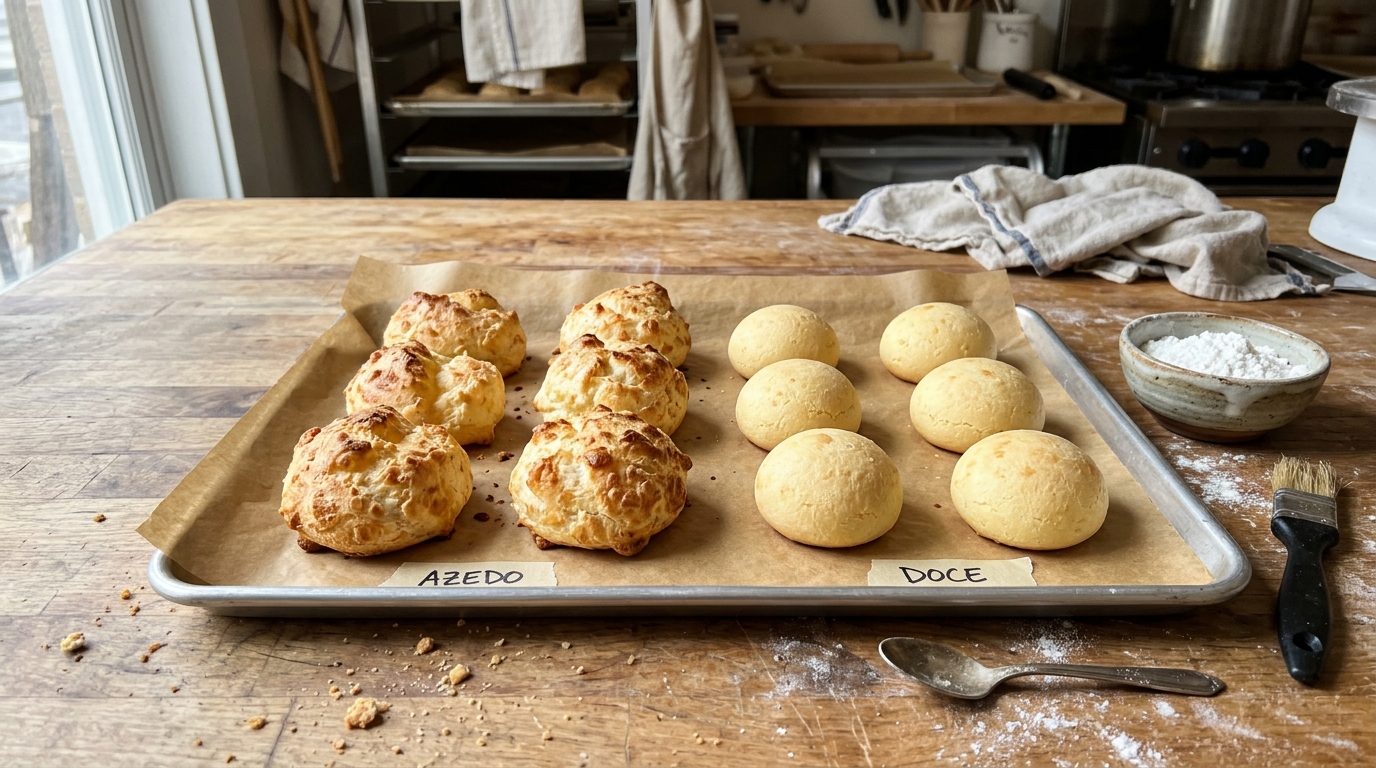
A deep commercial analysis of the physical, chemical, and rheological differences between naturally fermented sour cassava starch (Polvilho Azedo) and neutral sweet tapioca flour (Polvilho Doce) for high-expansion baking.
Commercial Formula Ingredients
Scaled Batch- ARCO Naturally Fermented Sour Cassava Starch (Polvilho Azedo)1.5 kg (Test Batch A: Pure Sour)
- ARCO Sweet Tapioca Flour (Polvilho Doce)1.5 kg (Test Batch B: Pure Sweet)
- ARCO 50/50 Balanced Starch Blend1.5 kg (Test Batch C: Hybrid Commercial)
- Whole Milk & Filtered Water (50/50)600 g per batch
- Vegetable Oil / Pure Lard220 g per batch
- Aged Queijo Meia Cura / Sharp Parmesan Blend650 g per batch
- Whole Fresh Eggs350 g per batch
- Fine Sea Salt25 g per batch
Production & Culinary Method
The Chemistry of Polvilho Azedo (Lactic Acid Fermentation)
Polvilho azedo undergoes 20 to 60 days of submerged microbial fermentation dominated by lactic acid bacteria (Lactobacillus plantarum), followed by intense sun-drying (UV solar irradiation). This photochemical oxidation cleaves amylose and amylopectin chains, dramatically lowering paste viscosity while creating volatile organic acids (pH ~4.0). Under oven heat, water vapor expands explosively through the weakened starch matrix without requiring chemical yeast.
The Chemistry of Polvilho Doce (Native Neutral Starch)
Polvilho doce is extracted and dried quickly without fermentation (pH ~6.0). Its intact high-molecular-weight amylopectin granules produce high peak viscosity, exceptional gelatinization clarity, and a dense, elastomeric, chewy crumb structure with minimal expansion.
The Scalding Process (O Escaldado)
Heat the liquid milk/water blend and vegetable oil to a rolling boil (100°C). Pour immediately over the starch in a planetary mixer fitted with a paddle attachment. Scalding pre-gelatinizes roughly 20–30% of the starch granules, creating a stable hydrogel capable of holding cheese solids and emulsified fats.
Emulsification, Cheese Folding, and Shaping
Incorporate eggs one by one on low speed until dough becomes smooth and pliable. Fold in the grated aged cheese. Roll dough into 30g round spheres. For commercial operations, freeze unbaked spheres on IQF trays at -20°C.
Baking Dynamics and Comparative Evaluation
Bake at 390°F (200°C) for 22 to 25 minutes until golden. Batch A (Pure Sour) expands by 300% with a hollow airy center and crisp shell. Batch B (Pure Sweet) expands by 140% with a dense, wonderfully chewy, stretchy cheese interior. Batch C (50/50 Blend) achieves the legendary commercial sweet spot: crisp outer crust with a pillowy, meltingly elastic cheese center.